Real Estate CRM for Channel Partner Management: How Builders Can Increase Broker Sales
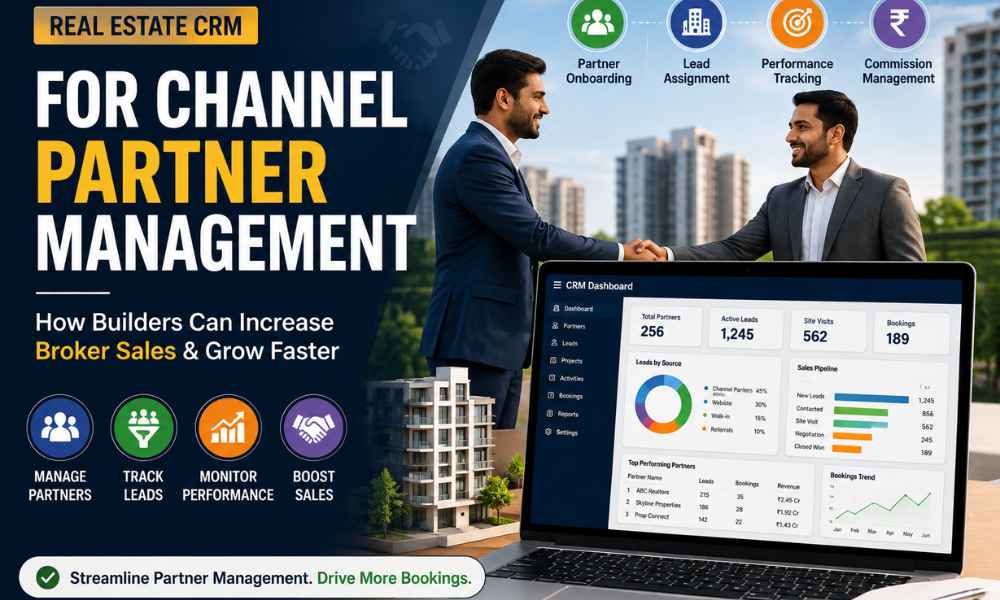
Introduction
Builders and real estate developers rarely depend on their internal sales team alone. Channel partners, brokers, property consultants, and referral agents can play an important role in generating property enquiries and bookings.
But managing a large network of channel partners can become complicated.
A developer may have hundreds of brokers working across different locations and projects. Each partner may bring leads through different channels, promote different properties, and require regular communication from the sales team.
When this information is managed through spreadsheets, emails, phone calls, and separate messaging groups, it becomes difficult to answer simple questions:
- Which broker generated this lead?
- Has the lead already been contacted?
- Which channel partner is generating the most site visits?
- Which partners are converting the most bookings?
- How many leads are currently active?
- Which projects are performing best through channel sales?
- Are duplicate leads being submitted by different brokers?
- How should commissions be tracked?
This is where real estate CRM for channel partner management can help.
A CRM gives builders a centralized system for managing channel partners, tracking their leads, monitoring sales activity, and understanding which partnerships are actually contributing to revenue.
What Is Channel Partner Management in Real Estate?
Channel partner management refers to the process of managing external sales partners who help promote and sell properties.
These partners can include:
- Real estate brokers
- Property consultants
- Independent agents
- Referral partners
- Brokerage firms
- Channel sales agencies
Instead of handling every enquiry directly, builders can work with these partners to expand their sales reach.
For example, a residential developer launching a new apartment project may have 100 registered brokers promoting the project.
Those brokers can generate enquiries, arrange buyer interactions, and refer customers to the developer's sales team.
Without a centralized system, managing these activities becomes difficult.
A channel partner CRM brings partner information, lead activity, sales progress, and performance data into one platform.
Why Builders Struggle to Manage Channel Partners
Channel sales can generate valuable business, but managing the network manually creates several challenges.
1. Too Many Partner Records
As the partner network grows, maintaining accurate broker information becomes difficult.
A developer may need to track:
- Partner name
- Company
- Contact details
- Location
- Assigned projects
- Active leads
- Sales generated
- Booking history
A centralized CRM makes this information easier to organize.
2. Duplicate Leads
Duplicate lead submissions are a common problem when several brokers work with the same buyer.
For example, one customer may contact three different brokers about the same property.
If each broker submits the customer separately, the developer may end up with multiple records for the same prospect.
A CRM can help sales teams identify duplicate information and maintain a clearer record of lead ownership.
3. Limited Visibility Into Partner Performance
Not every channel partner contributes equally.
One broker may generate 50 enquiries but only one booking, while another may generate 15 enquiries and five bookings.
Simply counting leads doesn't tell the full story.
Developers need to evaluate:
Leads → Qualified Leads → Site Visits → Negotiations → Bookings
This provides a clearer picture of partner performance.
How a Real Estate CRM Improves Channel Partner Management
A specialized CRM can bring structure to the entire partner-sales process.
1. Centralized Partner Database
Instead of keeping broker details across spreadsheets and email conversations, developers can maintain a centralized partner database.
The sales team can quickly view partner information and activity from one location
This becomes particularly useful when a developer has multiple projects or operates across several cities.
2. Lead Registration and Ownership
Channel partners can submit buyer enquiries to the sales team.
The CRM can record:
- Lead name
- Contact information
- Property interest
- Project
- Source
- Partner name
- Lead registration date
- Current sales stage
This makes it easier to understand where every opportunity came from.
3. Project-Wise Partner Management
Developers often sell multiple projects simultaneously.
A broker may promote Project A while another partner focuses on Project B.
With CRM-based management, businesses can organize channel partner activity according to individual projects.
This helps sales managers understand:
- Which partners promote each project
- Which projects generate more partner leads
- Which partners convert better for specific properties
Track the Complete Channel Sales Journey
A major advantage of using CRM software is the ability to track the partner-generated lead through different stages.
A typical workflow can look like:
Partner Registered → Lead Submitted → Lead Verified → Sales Assigned → Customer Contacted → Site Visit → Negotiation → Booking → Closure
This gives management a clear view of where opportunities are progressing or getting delayed.
Measure Channel Partner Performance With the Right KPIs
A good channel partner strategy should be based on measurable performance rather than assumptions.
Important KPIs include:
Leads Generated
How many enquiries did each partner submit?
Qualified Leads
How many submitted leads actually matched the project's target buyer profile?
Site Visits
How many prospects visited the property?
Booking Conversion
How many partner-generated leads became bookings
Revenue Generated
How much sales value did each partner contribute?
Conversion Rate
What percentage of leads eventually became customers?
Project-Wise Performance
Which project generates the strongest results through channel partners?
These metrics help sales managers identify high-performing partners and improve underperforming partnerships.
How CRM Helps Builders Identify Their Best Channel Partners
Imagine a developer has 200 registered brokers.
Looking only at the number of enquiries might produce misleading results.
Consider these examples:
| Partner | Leads | Site Visits | Bookings |
|---|---|---|---|
| Partner A | 80 | 18 | 2 |
| Partner B | 35 | 16 | 6 |
| Partner C | 20 | 10 | 5 |
Partner A generated the highest number of leads.
But Partner B and Partner C produced significantly better booking results.
A CRM dashboard can make these differences easier to identify.
This allows management to focus relationship-building efforts on partners who deliver quality opportunities rather than simply generating large volumes of enquiries.
Improve Communication With Channel Partners
Good partner relationships require consistent communication.
Developers may need to share:
- New project launches
- Price updates
- Inventory availability
- Offers
- Construction updates
- Payment information
- New marketing materials
- Site visit information
A centralized CRM can help teams maintain organized communication and ensure important information reaches the right partners.
Manage Property Inventory More Effectively
Channel partners need accurate property information before recommending units to customers.
If inventory information is outdated, brokers may promote units that are already unavailable.
This can create confusion and damage customer trust.
When CRM and inventory information are connected, sales teams can work with more accurate availability data.
For developers handling multiple projects, towers, floors, or unit types, this can become especially valuable.
Channel Partner CRM and Commission Tracking
Commission management is another important part of channel sales.
Developers may have different commission structures depending on:
- Project
- Property type
- Partner category
- Booking value
- Sales target
- Promotional scheme
A structured CRM workflow can help businesses maintain records associated with partner-generated bookings.
Instead of searching through emails and spreadsheets, the sales team can connect partner information with the corresponding sales opportunity.
For actual commission calculation and payment processing, businesses should configure the CRM according to their specific commercial agreements and accounting process.
Why Real Estate CRM Is Better Than Spreadsheets for Channel Sales
Spreadsheets can work when a business has a small number of partners.
But as the partner network grows, problems become harder to control.
| Spreadsheet-Based Management | CRM-Based Management |
| Manual partner records | Centralized partner database |
| Difficult lead ownership | Lead source and ownership tracking |
| Limited reporting | Real-time dashboards |
| Manual updates | Structured workflows |
| Duplicate records are harder to identify | Better data organization |
| Difficult project-wise analysis | Project-wise reporting |
| Limited team visibility | Centralized access |
The objective isn't simply to replace Excel.
The real objective is to create a more reliable channel-sales process.
What Features Should a Channel Partner CRM Have?
Before choosing a CRM, builders should evaluate whether it supports their actual sales workflow.
Important features include:
Partner Database
Store and organize broker and channel partner information.
Lead Registration
Allow partner-generated enquiries to be recorded and tracked.
Lead Ownership
Maintain visibility into who submitted and manages each opportunity.
Project Mapping
Connect partners and leads with specific projects.
Sales Pipeline
Track opportunities from registration to booking.
Performance Dashboards
Measure partner-wise and project-wise performance.
Inventory Visibility
Help sales teams work with current property availability.
Communication Management
Keep relevant partner interactions organized.
Role-Based Access
Control what sales managers, executives, and partners can access.
Reports and Analytics
Generate useful insights for management decisions.
How to Build a Better Channel Partner Strategy
CRM software is only one part of successful channel sales.
Developers should also focus on partner relationships.
Segment Your Partners
Not every partner should receive the same level of attention.
Group partners based on factors such as:
- Sales performance
- Location
- Project specialization
- Lead quality
- Booking history
Set Clear Expectations
Define:
- Lead registration rules
- Lead ownership periods
- Communication process
- Documentation requirements
- Commission terms
- Escalation procedures
Clear rules reduce disputes and confusion.
Reward Consistent Performance
Developers can create partner programs based on measurable performance.
For example:
- Monthly sales targets
- Quarterly incentives
- Recognition programs
- Exclusive project opportunities
The exact structure should match the developer's business model and commercial policies.
How TranquilCRM Can Support Real Estate Channel Sales
For builders and developers, channel partner management is often part of a larger property-sales workflow.
TranquilCRM can be positioned as a centralized platform for managing real estate sales activities, including lead management, customer interactions, project workflows, and sales tracking.
For a business using channel partners, the important objective is to connect partner-generated opportunities with the wider sales process rather than managing partners separately.
This allows sales teams to maintain better visibility from the initial enquiry through later stages of the property sales journey.
The exact CRM configuration should be based on the developer's projects, partner structure, sales process, and reporting requirements.
Benefits of Using CRM for Channel Partner Management
- Better partner visibility
- More organized lead registration
- Reduced data duplication
- Faster sales coordination
- Improved project-level reporting
- Better partner performance analysis
- More consistent communication
- Greater sales-team accountability
- Easier management of growing partner networks
The biggest benefit is visibility.
When management can clearly see which partners, projects, and sales activities are producing results, it becomes easier to make informed decisions.
Frequently Asked Questions
What is a channel partner CRM in real estate?
A channel partner CRM is software that helps builders and developers manage brokers, property consultants, referral partners, and their sales activities from a centralized system.
Why do builders need channel partner management software?
Builders use channel partner management software to organize partner information, track partner-generated leads, monitor sales performance, and improve coordination between brokers and internal sales teams.
Can a CRM track leads generated by different brokers?
Yes. A properly configured CRM can record the source and ownership of leads, allowing sales teams to identify which channel partner generated each opportunity.
How can CRM help reduce duplicate leads?
CRM systems can organize customer records and provide visibility into existing enquiries, helping teams identify potential duplicate submissions before they create confusion.
What KPIs should developers track for channel partners?
Important metrics include leads generated, qualified leads, site visits, bookings, conversion rates, revenue generated, and project-wise partner performance.
Can channel partners manage multiple real estate projects?
Yes. A suitable CRM can organize partner activities by project, allowing developers to monitor which partners are generating opportunities for specific properties.
Is channel partner CRM useful for small builders?
Yes. Even smaller developers can benefit from structured partner management, particularly when several brokers are working on the same project.
What is the difference between CRM and channel partner management software?
A CRM manages customer and sales relationships broadly, while channel partner management focuses specifically on external sales partners and the opportunities they generate. A real estate CRM can combine both functions
Final Thoughts
Channel partners can become a powerful sales channel for real estate developers, but managing a growing broker network requires more than spreadsheets and scattered communication.
A real estate CRM gives builders a structured way to organize partners, track lead ownership, monitor sales progress, measure performance, and connect partner-generated opportunities with the broader property-sales process.
The goal isn't simply to have more channel partners.
The goal is to build a channel network where the developer knows which partners are producing quality leads, which projects are performing, where opportunities are progressing, and where the sales process needs attention.
As real estate businesses expand their partner networks, centralized channel partner management can become an important part of building a predictable and measurable sales operation.